News
4 MIN READ
February 20, 2026
I Just Had a Golf Swing Epiphany—And It Could Help You Too
For the last few years, I realized hadn’t been building the swing—I’d been fighting it. Here's the fix.

Winter is brutal on the golf game. For several months each year, people like me are stuck inside, daydreaming about warm air and emerald fairways. A forced break can be welcome for a while—this game does plenty of damage to the psyche—but as the weeks drag on, the itch inevitably returns. Thankfully, there’s finally a glimmer of hope at the end of the tunnel—no thanks to Punxsutawney Phil.
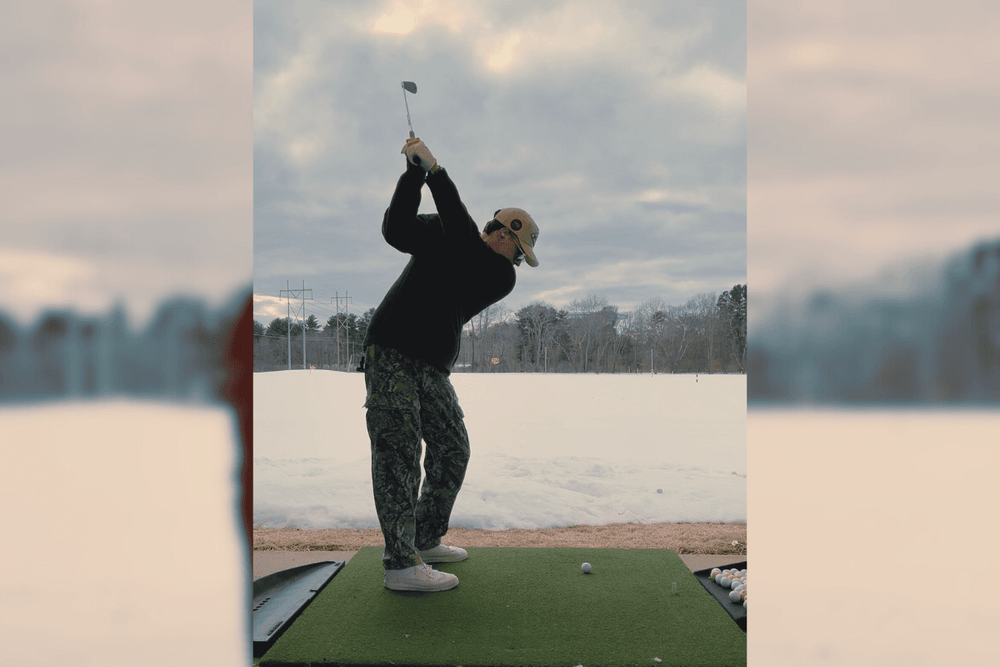
A few days ago, the temperature crept toward 40 degrees—a downright balmy afternoon for someone who’s endured months of sub-freezing misery. I did what any golf-starved soul would do: hopped in the car and drove to my local, year-round range.
With the overhead heater blasting, I pulled on my long-neglected Titleist Perma-Soft glove and plucked my 60-degree wedge from the bag. Just like that, I was back.
My expectations were modest. Rust doesn’t disappear overnight. Still, even by my deliberately low standards, the results weren’t pretty.
Contact came from everywhere but the center of the clubface. The scuffed range balls left their chalky autographs in all the wrong places, and I couldn’t quite match feel with intention. Strangely, frustration never arrived. I was swinging a club again. For the first time in months, that was more than enough.
After a hot shower thawed me out and a few lazy minutes on the couch watching The Pitt, my thoughts drifted back to my swing.
What was behind the inconsistent contact? Had a few months away subtly altered my grip? Or was this just one of those days every golfer eventually faces? My mind kept circling until it landed on an old feel.
In 2019, just before graduating from college, I took the PGA Playing Ability Test—the hurdle every aspiring professional must clear for PGA membership. I passed, barely, clinging to a single swing thought: start everything with rotation and the left arm.
And then it hit me.
A cartoon lightbulb might as well have flickered on above my head. Somewhere along the way, I’d abandoned the very move that once got me through. For the last few years, I hadn’t been building the swing—I’d been fighting it.
Over the past few seasons, I’d let my right hand take control. The takeaway grew shut, steep, drifting outside my hands, and from there I couldn’t stop yanking the handle in transition. I learned to survive with it—when the snow fell last year, I was playing to a 4.5 handicap—but consistency remained my nemesis.
I shot up from the couch, pulled my pitching wedge from the bag, and hurried to the nearest mirror. One rehearsal of that old feel—and suddenly, everything clicked.
The clubface matched my hand path when the shaft was parallel. At the top, the club sat a touch more laid off. From there, it shallowed naturally, dropping into the slot without force. For the first time in a long time, the motion felt organized.
I could’ve cried (not really, but really). True Golf Sicko behavior (shout out to the Dan on Golf boys).
All that to say: if you’re fighting an overactive right hand—or left hand, for the lefties—there’s hope.
The rediscovery sent me back down the YouTube instruction rabbit hole—I’m nearly 29 and still haven’t taken my first real lesson—and this video from Porzak Golf might be the clearest explanation I’ve heard for anyone dealing with the same issue. Turns out there’s only so much you can self-diagnose between range sessions.
With more snow in the forecast this weekend, it looks like I’ll have a few extra weeks to rehearse this “new” feel in the living room before I let it see the golf course.
The prestigious scratch tag? I’m coming for it this season. Delusion optional. Confidence mandatory.

JOIN OUR NEWSLETTER
Get our top stories in your inbox, including the latest drops in style, the need-to-know news in pro golf, and the latest episodes of Skratch’s original series.