News
9 MIN READ
July 29, 2026
What 50 Years of the AIG Women's Open Means to Someone Who's Lived It
As the championship celebrates its 50th anniversary, 2004 winner Karen Stupples looks back on the evolution of the Women's British Open—and why winning it has always meant more than a trophy.

Dame Laura Davies said it best about the evolution of the AIG Women's Open, the crowds have grown, the television coverage has expanded, the prize purse has skyrocketed, but the significance of winning this championship has never changed.
Today, the AIG Women's Open stands among the crown jewels of women's golf. Backed by a record $10 million purse, major championship status and a championship rota that visits some of the world's most iconic links courses, it has become one of the most anticipated weeks on the women's golf calendar.
Fifty years ago, none of that was a guarantee.
When the Women's British Open debuted at Fulford Golf Club in 1976, the winner's check was worth just £210 (which is roughly $280 USD in today's standards). The tournament was an extension of the Ladies' Amateur Stroke Play Championship, and featured only a handful of professionals and remained nearly 25 years away from earning major championship status. Fittingly, the first champion wasn't an established LPGA star but rather an amateur.
Jenny Lee-Smith became the inaugural winner, embodying what the championship represented in its infancy: not prestige, but possibility. Before it became one of the most celebrated titles in women's golf, the Women's British Open was a proving ground for the players determined to push the game, and themselves, forward.

Jenny Lee-Smith winner of the 1976 Women's British Open at Fulford Golf Club on August 21, 1976 in Fulford, England. (Photo by Peter Dazeley/Getty Images)
2026 AIG WOMEN'S OPEN: The Favorites, Sleepers, and Wild Cards to Watch at the AIG Women's Open
Few people have experienced that evolution in its completion quite like Karen Stupples. Before she became a champion and lifted the trophy high in 2004, she experienced this open as a young British golfer dreaming of competing on its biggest stage, just like Lee-Smith.
Her first encounter with women's golf and the championship, like many young golfers of her generation, was through newspaper stories, where she familiarized herself with the names that appeared in them. "My first real experiences of [the Open] was qualifying for it in '96 as an am -- I already had a decent amateur career, but I was, you know, still trying to find my way through and figure out what I wanted to do."
Stupples stepped foot onto Woburn Golf Club, and suddenly, those names that she was reading about in the paper were standing beside her on the first tee. Though the championship was still developing its identity, for young players like her, simply earning a place in the field felt like a glimpse into another world.
[For] a player from the UK and from Europe, this is the one that that we all grew up watching and and dreaming of winning...It just plants that seed of where you could be in the world of golf. Like it it gave me an opportunity to see what my potential could be if I just persevered enough, if I just worked hard enough. I had an opportunity to make a career, make a living playing golf and win the British Open...these things were were planted in me at a very young age because of the AIG Women's Open.

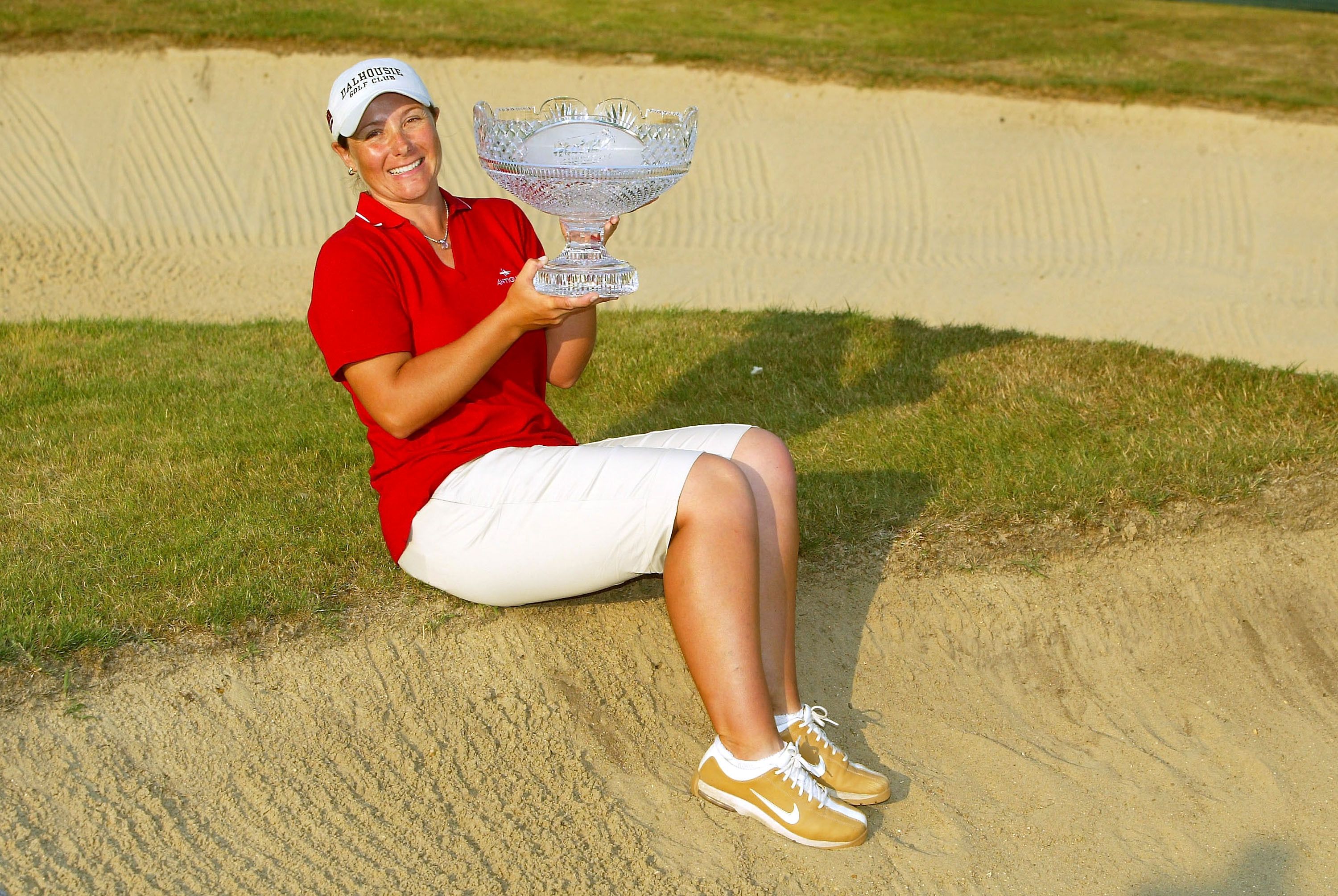
Karen Stupples of England acknowledges the crowd after winning the Weetabix Womens British Open with a score of 19 under par, at Sunningdale Golf Club on August 1, 2004 in Sunningdale, England.(Photo by Warren Little/Getty Images)
"I remember looking around and seeing superstars everywhere," Stupples described. "There's Laura Davies, there's Alison Nicholas, there's Trish Johnson…The same way as the U.S. Women's Open does the in America for the American girls, that it plants that seed into them into their minds to say, this is this is what I want to do...This is the big one for all of us over here. It's it's just that hope that this is what your life could be."
She got her first taste of what her life as a golfer could be, she'd go on to turn pro in 1998, and play her rookie season on the LPGA in 1999.

By the time the Women's British Open arrived at Sunningdale in 2004, Karen Stupples was no longer the wide-eyed amateur soaking in the atmosphere. Eight years after qualifying for her first championship at, she had established herself on the LPGA Tour, collecting a slew of top-10s, but the breakthrough victory she'd been chasing had yet to happen.
Fresh off a fourth-place finish at the Evian Masters (now the Amundi Evian Championship), Stupples believed her best chance to win one of the year's biggest events had already come and gone. In fact, despite her coach predicting months earlier that Sunningdale would suit her game perfectly, she never gave it much thought. "I thought, 'Yeah, yeah, yeah, whatever,'" Stupples said with a laugh.
But she arrived at Sunningdale carrying the confidence she'd found the week before, and her ball-striking remained as sharp as ever. After briefly falling out of the lead, she entered Sunday's final round just one shot back. Knowing she needed a fast start, Stupples delivered one of the most remarkable openings in championship history—an eagle at the first followed by an albatross at the second.
"I thought, 'Ooh... maybe today's my day,'" she recalled. The shots became part of Women's Open lore, but they aren't what Stupples remembers most.
What has stayed with her is the feeling of playing a home championship surrounded by people who had believed in her long before she became a major champion. English flags lined the fairways. Fans shouted, "Come on, Karen," as she walked from green to tee. It wasn't until she stood on the 15th tee, clinging to a one-shot lead, that the magnitude of the moment truly settled in. "I wasn't particularly nervous at all until I got to the 15th tee," she said. "I realized the finish line was coming."
Stupples steadied herself with a birdie-birdie-birdie-par finish to secure the title, but when she reflects on that week more than two decades later, the trophy isn't the first image that comes to mind. Instead, she thinks about the people waiting for her when the final putt dropped.
Her parents were there, along with the coaches, mentors and friends who had sacrificed to help a young woman chase a dream that, at times, felt impossible. For Stupples, winning the Women's British Open wasn't simply a career-defining moment—it was a chance to repay everyone who had helped make it possible.
"It was amazing to do it in front of my fans and my family," she said. "I wanted it so much more for them because of everything that they had given me. I always thought I was going to be the player who was close, but not quite. Then I did it. It was very satisfying for so many more reasons other than the trophy."
Everybody that has won this championship has had one of those moments where, as a kid, they wished to win the British Open or a major championship. Sometimes those wishes get answered. This is one of those championships that can make that happen.
And more than two decades removed from her career-defining win, she's still part of the championship, this time inside the broadcast booth, walking the fairways, calling the action and helping tell the story of an event she has lived from nearly every angle.
But the English star is only one chapter in a much larger story. Over five decades, every champion has helped shape the identity of the AIG Women's Open. From Jenny Lee Smith's amateur breakthrough in the inaugural championship to the global stars who elevated its stature to players like Karrie Webb, Annika Sörenstam, Lorena Ochoa and the generations that followed added their own unforgettable moments, turning the championship from an ambitious idea into one of the most meaningful titles in women's golf.
Yet for all the changes the championship has undergone, the larger purses, the worldwide audience and its place among the game's five majors, the feeling at its core has remained the same. The AIG Women's Open has always represented possibility: the chance for a player to step onto one of golf's greatest stages and accomplish something they once only dreamed about.
For Stupples, the championship's future is tied to preserving the qualities that have made it special from the beginning. She hopes the AIG Women's Open continues to embrace the history and character of the courses it visits, while giving players the opportunity to showcase a different side of the game.
"I hope that the R&A continues to take it to historic, fantastic courses that have a history that can provide drama and challenge for the players," Stupples said. "I hope that they continue to keep respecting the women's game in the way that they have with regards everything that they do."
She believes that part of that respect comes from maintaining the unique challenge of links golf—a style of play built on creativity, imagination and adaptability. "I think that's what links [golf] brings," she explained. "It allows the world to see a different type of golf that is not flying it to point A and then flying it to point B and then making a putt. It requires a little bit of feel, a little bit of creativity."

Above all else, that sense of possibility is what will define the AIG Women's Open for the next 50 years. The purses will continue to grow, the audiences will continue to expand and the championship will continue to evolve—but the meaning of winning it will remain unchanged.
For Stupples, that feeling was once a young golfer reading about the greats of women's golf in the newspaper, hoping one day to compete alongside them. Years later, she became one of those names herself—forever connected to a championship that has spent five decades turning childhood dreams into history.

JOIN OUR NEWSLETTER
Get our top stories in your inbox, including the latest drops in style, the need-to-know news in pro golf, and the latest episodes of Skratch’s original series.