News
6 MIN READ
September 14, 2026
Love Letter To: Eastward Ho!
On a skinny peninsula on Cape Cod's eastern coast lies a hidden gem, laid over the land like a blanket, reminiscent of golf’s earliest days on Scotland’s shores.

Eastward Ho! shouldn't exist. It's entirely impractical, resting on a small peninsula that protrudes off of Cape Cod's coast, marking the southern edge of Pleasant Bay. This skinny piece of land should lend itself to jumbled routing and holes that seem to step over each other. The lack of space should restrict creative freedom. It should feel monotonous. But, somehow, on this undulating strip of grass with wind gusting in off the Atlantic from every direction, William Herbert Fowler built a masterpiece.
And before you ask, yes the exclamation point is part of this course's official name and not the mark of an overzealous writer that cannot contain himself after visiting such an incredible waterfront property. The punctuation choice is a nod to the UK's Westward Ho! coastal village with a namesake golf course also designed by Fowler.
Fowler's East Coast art piece is positioned on the sharp elbow of the flexed arm that is Cape Cod in Chatham, Massachusetts. The area was first settled by the Nickerson family in the mid-1600s. Their family house sat at the head of Ryder Cove, shouting distance from where Eastward Ho!'s 12th green sits today. But it wasn't until the early 1900s that the point, which had become known as Nickerson's Neck, was identified as the potential site of a new golf course, with hopes of rivaling the challenge and links design of courses well-known in the British Isles.
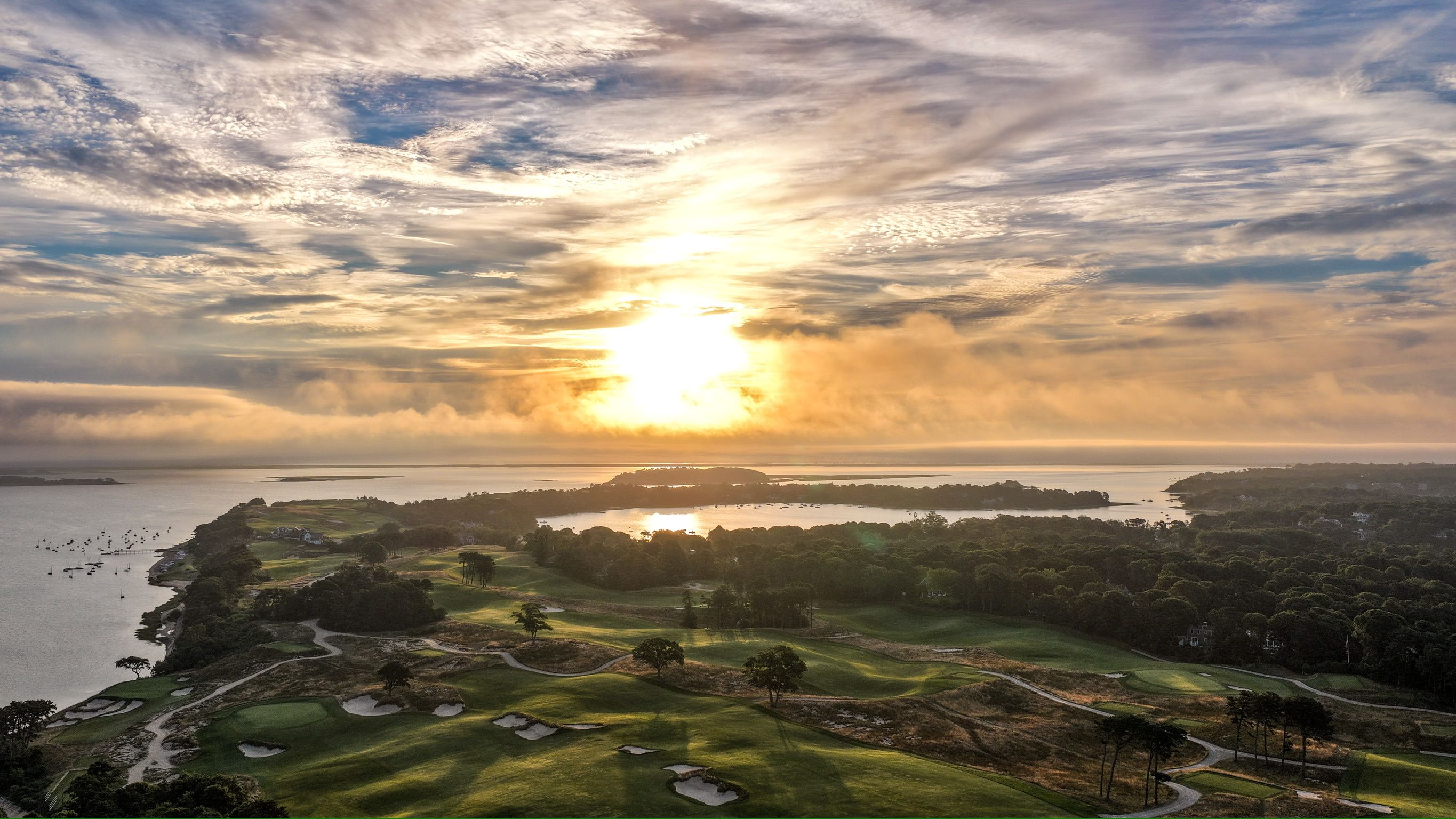
A drone shot overlooking much of Eastward Ho!, facing east into the Atlantic.
Looking at Eastward Ho! today, it's easy to see why this piece of land was chosen. It would be hard to traverse the rolling fairways, feel the push of the swirling sea-breeze, or scratch through the sand and heather without being reminded of golf's origins across the Atlantic. But on America's eastern seaboard, it feels entirely unique.
It's also clear that Eastward Ho!, a course meant to be walked, not driven, is going to be a climb from the moment you step on the first tee. After a gentle drop to an inviting fairway, the green rests stories over your head. It’s the first omen of the peaks and valleys, crests and hollows, swales and bowls to come.
These aren't just your typical undulations, either. The course's first par-3, usually a mid-iron approach into a sprawling, Biarritz design, features a gulley that runs through the middle of the putting surface, seemingly dug by a shovel-wielding giant, settling three or four feet below the green's front. The fairway of the sixth hole, a par-4 running back toward the sea, curves wildly around towering mounds, its left side rising skyward, 20-odd yards above the right. The green then steps up from the valley another 10 yards, forming a steep false front that more than half of our foursome fell victim to.
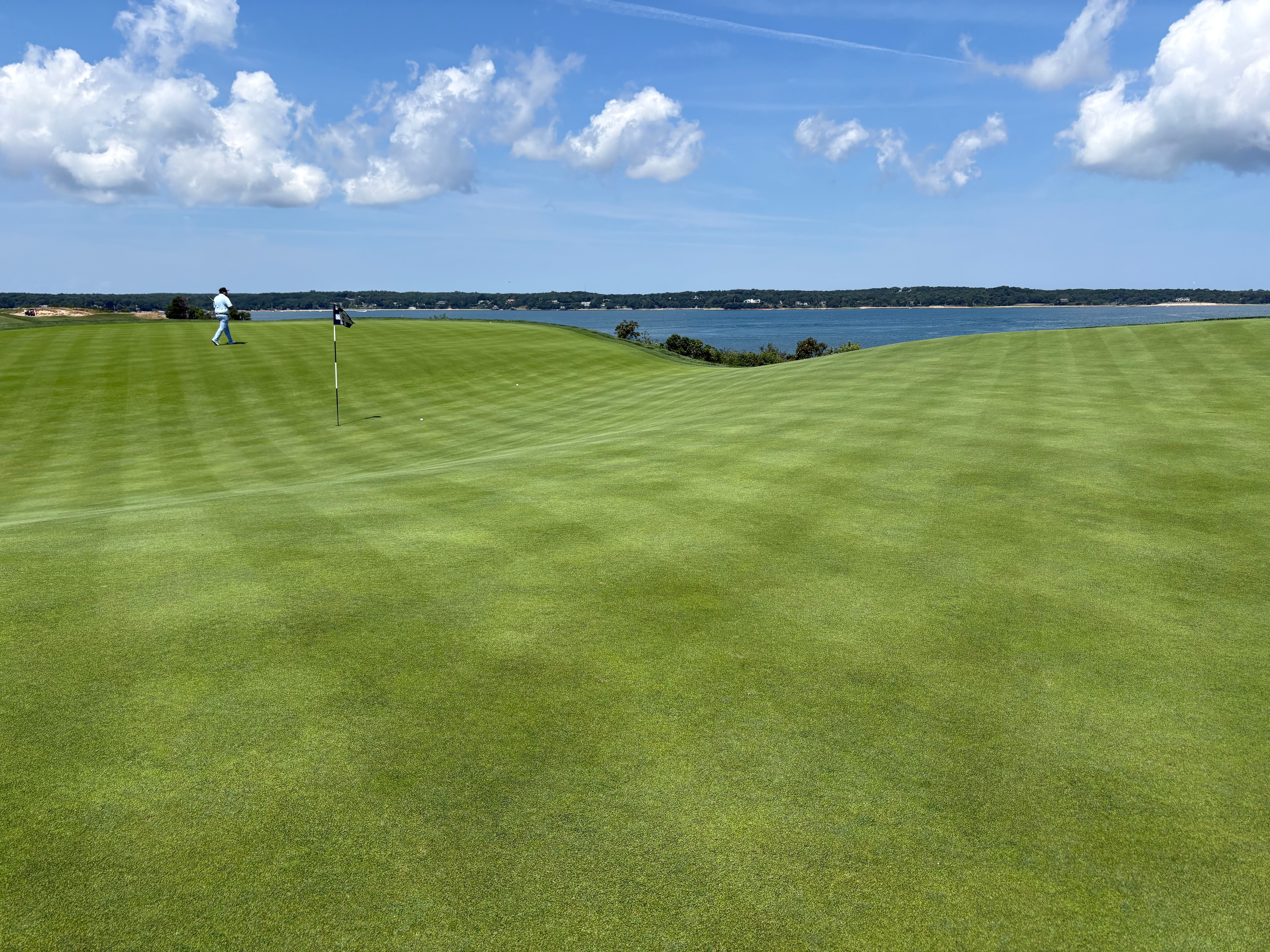
The green on the par-3 4th hole features one of the harsher Biarritz designs, with the central gulley falling several feet below the putting surface's front or back.
The course, which first welcomed golfers in 1922, was originally designed by William Herbert Fowler, known also for his designs of Walton Heath and the Berkshire Golf Club in England. It underwent a renovation by Keith Foster in 2004, meant to restore some of the original features that had eroded with the decades. Fowler’s designs are renowned for their naturalistic feel, going with the earth rather than moving it. Eastward Ho! is no different.
The movement in fairways and greens, only progressing throughout the routing, exists as evidence of golf’s relationship with the land on which it was built. Dirt was not flattened to ease the lies or decrease the blind shots. If anything, the land’s features were emphasized or exaggerated. The piece of land coupled with its exposure to the volatility of the Atlantic is almost reminiscent of Old Head, another course fixed on the precipice of the sea, pushing from Ireland’s southern coast and famed as the point nearest to the resting place of the Lusitania.
In that exposure to the treachery of the ocean lies Eastward Ho!’s second, more unpredictable defense. The course you play one day may feel completely separate from the next.
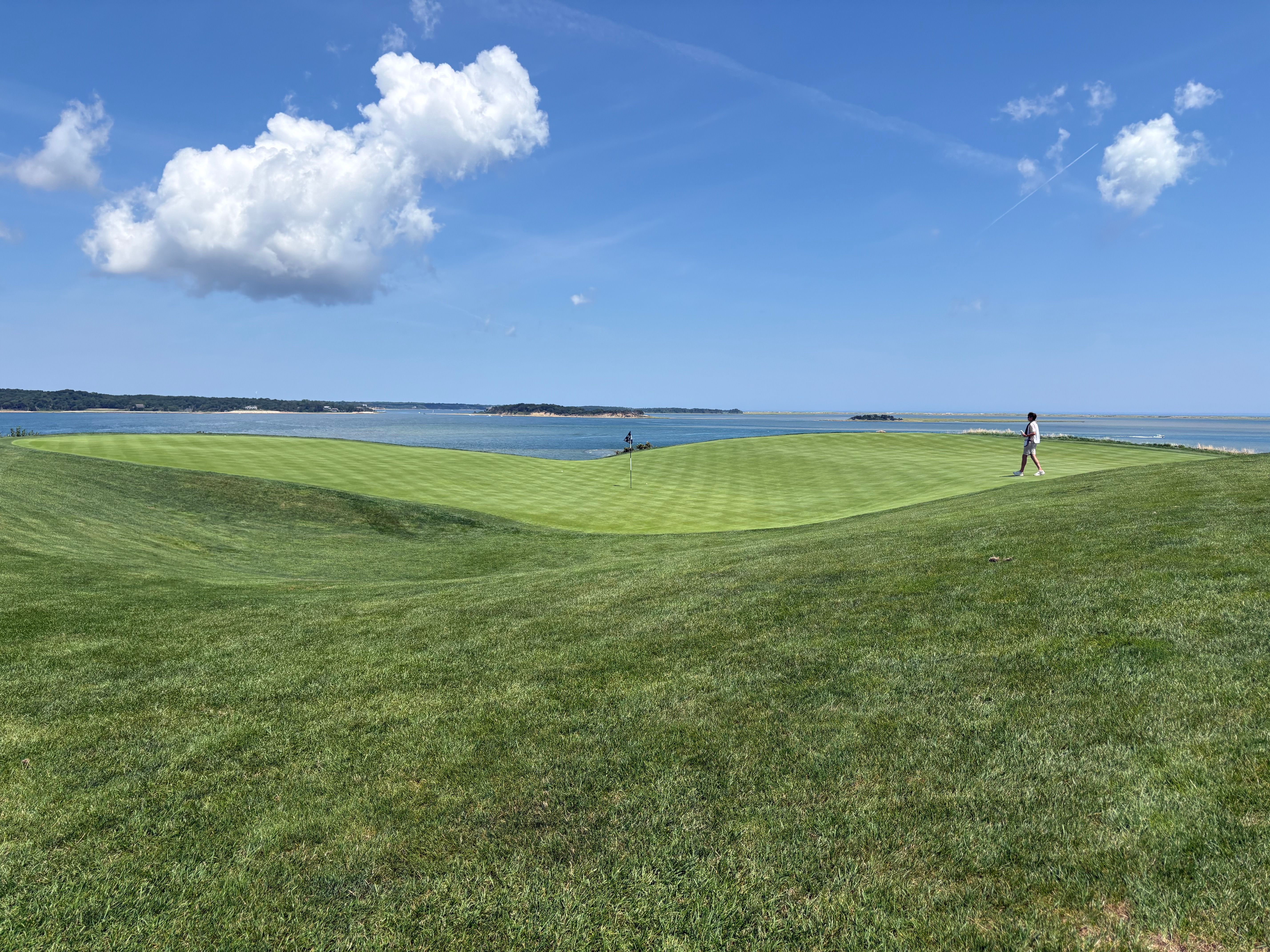
Eastward Ho!'s 4th green from the side looking north at the edge of Pleasant Bay.
I’ve been lucky enough to play Eastward Ho! twice in recent memory, with very opposite winds. The final hole, a roughly 450-yard par-4 returning to the clubhouse with the driving range to your right, was almost unrecognizable between the two days. On my first attempt, a well-struck drive nestled at the top of a large hill in the fairway, and only with a crisp 3-wood did I manage to find myself by the front of the green, across a deep valley. More recently, my drive–this time guided by a helping wind–scampered down the hill. A wedge was all that was needed to find the putting surface.
It is everything that golf should be. When you’re traversing the fairways, looking out over the smattering of sailboats speckled across Pleasant Bay, it almost feels as if Eastward Ho! has always been there. It wasn’t built, or manufactured, it couldn’t have been. When this land came to be, it must be that the grass just grew that way. Bunkers dug themselves into the earth, brown wisps of heather grouped together and stretched to outline long corridors of green. It’s all too natural for anything else.


The discovered-not-built feel of the place culminates in its clubhouse, which sits nestled between the 9th and 18th greens. Like its surroundings, the building appears plucked from the Cape’s earliest settlers, and with good reason. It was originally the home of a woman named Becky, the widow of Ensign Nickerson, whose surname had come to define the whole peninsula.
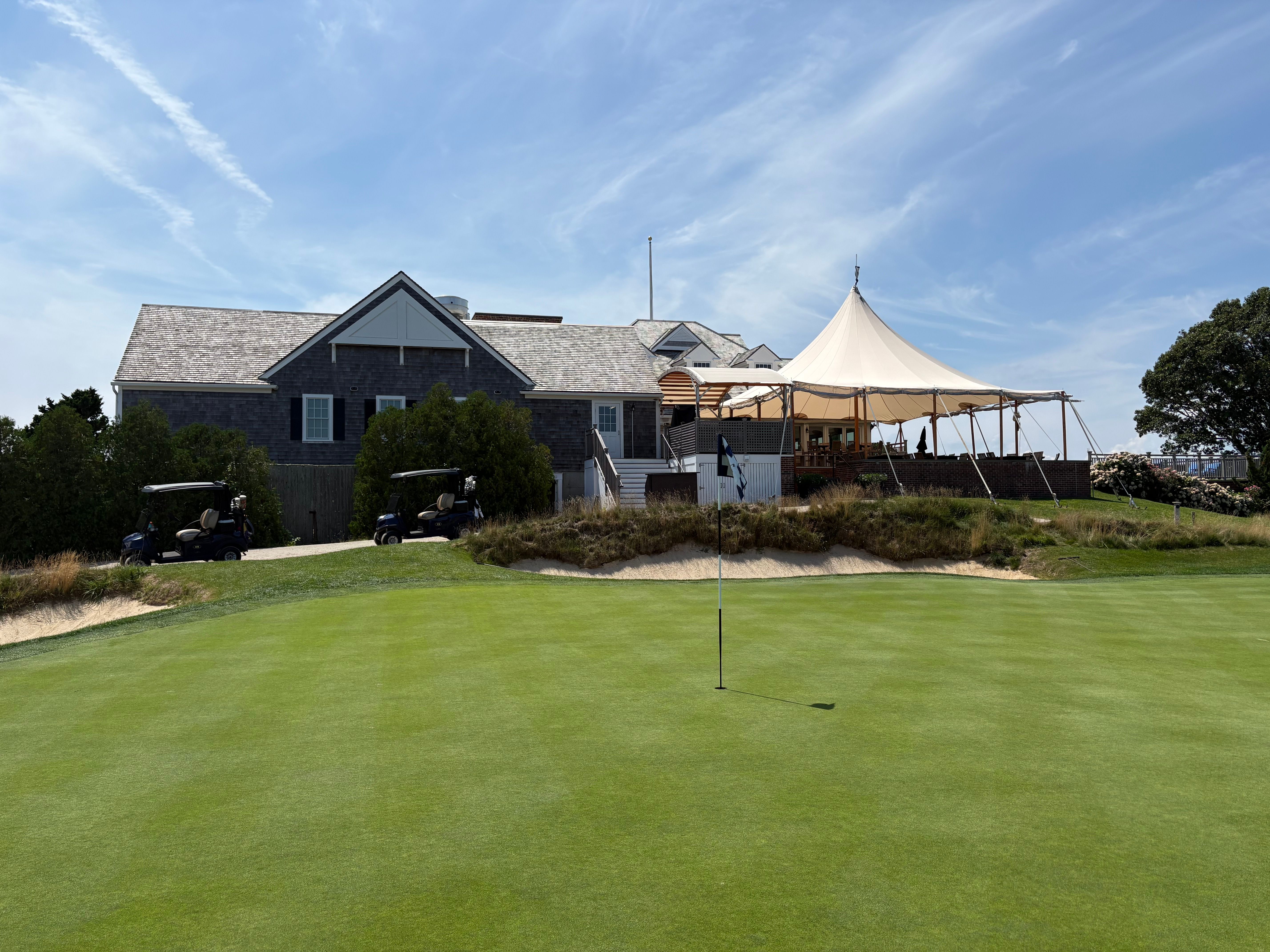
Eastward Ho!'s clubhouse stands behind the 9th green, separating the two nines.
It was refurbished by the Boston firm Little and Russell, but retaining the original charm of the home was of the utmost importance. The men’s locker room and bar, facing north towards Pleasant Bay, was originally an early 18th century cottage in Acushnet, Massachusetts, before it was transported to its current location.
Eastward Ho! is built on all that is beautiful about golf, and stands as an American reminder of the sport’s origin in Scotland’s windswept coastal dunes. Standing at the top of one of its many crests, surveying the land and sea around you, it’s easy to feel transported back in time. And with the swirling winds, unconventional lies, and confounding greens, it’s just as easy to put up a big number. But no matter if the winds are buffeting, if the putts won’t drop, or any other number of frustrations, it’s a course that you will leave bearing a new perspective on what golf means to you.
This story is part of Skratch Golf’s Love Letter series—an ode to the places that make the game unforgettable.

JOIN OUR NEWSLETTER
Get our top stories in your inbox, including the latest drops in style, the need-to-know news in pro golf, and the latest episodes of Skratch’s original series.